
What Happens to Your Electricity Bill After Installing Solar?
How self-consumption, grid imports and Solar ATAP exports appear in the monthly calculation
Quick links
A solar system does not simply subtract an amount from your bill. It changes how much electricity you buy, when you buy it and what you are credited for exporting—and your monthly bill reflects all three.
Three energy flows determine the result
Your bill is shaped by three separate quantities: solar electricity used immediately in the home, electricity imported from TNB and excess solar electricity exported through the bi-directional meter. Directly used solar does not need to be purchased from the grid, so it usually does not appear as a line of grid consumption.
The bill and the inverter-monitoring record answer different questions. The TNB bill records grid imports, exports and relevant charges. Solar monitoring records what the system generated. Looking at both gives a more complete picture.
How Solar ATAP credits domestic exports
For domestic Solar ATAP consumers, exported energy within the relevant limit can offset imported energy in the same billing period using the Energy Charge that applies to your TNB tariff. Export that remains unused for offset in that billing period is not carried forward. The export credit also does not remove every tariff component or relevant charge.
This is why the electricity bill may not fall in a straight line with total solar generation. Two homes can produce the same amount of solar power and still receive different bills. One may use more solar power directly, while the other exports more than it can offset that month.
Why your bill may still be higher than expected
Common reasons include higher electricity use at home, more night-time use, cloudy weather, temporary shading, an undersized system, inverter downtime or expectations based on a different tariff or export programme. Compare similar periods and check both generation and consumption before concluding that the system is underperforming.
Monitoring with the Verdant Home app
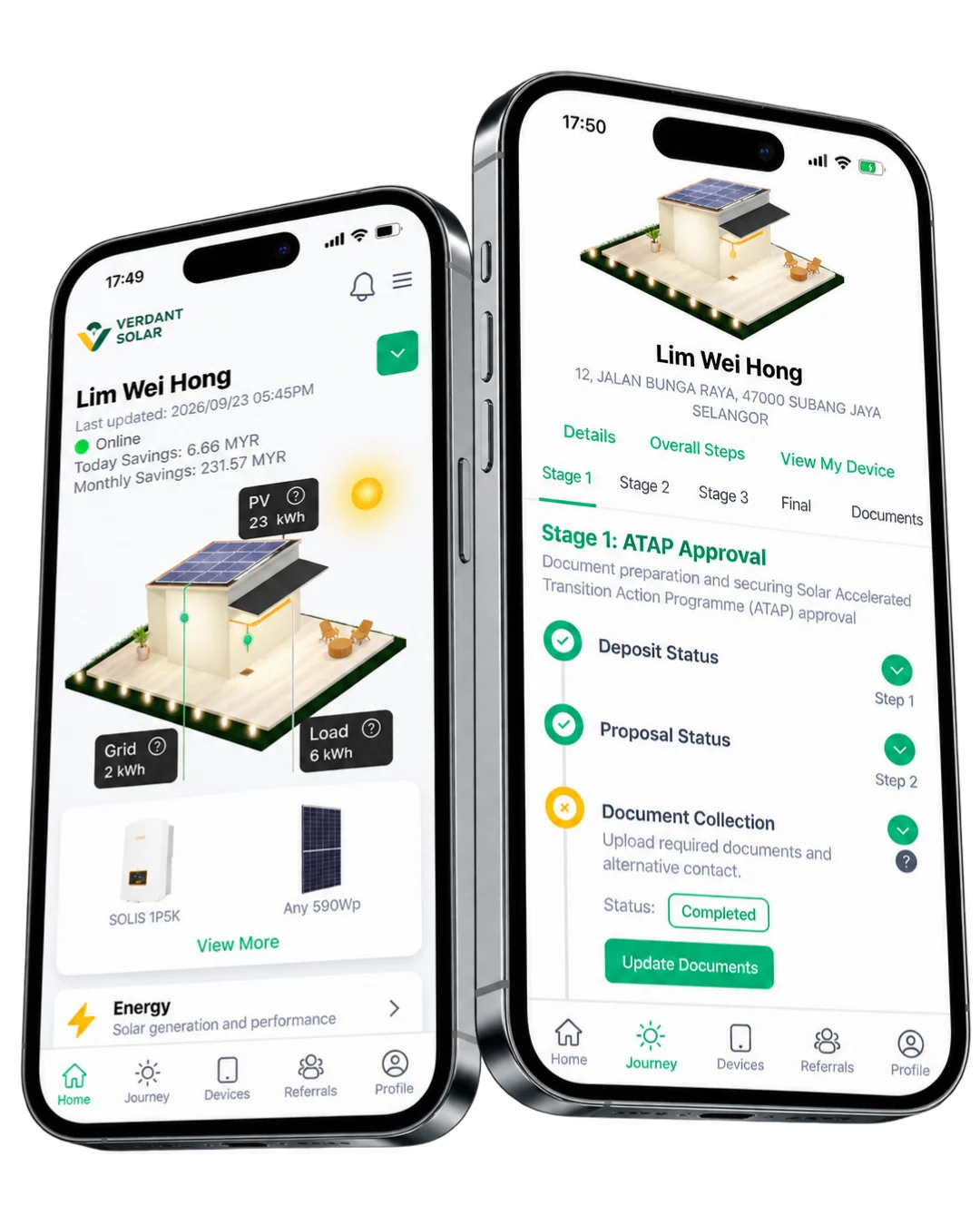
The Verdant Home app gives you a practical view of generation and estimated savings across daily, monthly and yearly periods. It can help identify a change in the performance pattern and provides useful information when asking for support.
Monitoring does not replace the official electricity bill, and estimated savings in the app are not an audited financial result. It is best used together with the bill, the proposal assumptions and any relevant system alerts.
What to check each month
Review the same few items each month so that a real change stands out from normal variation.
- Total generation for the month.
- That figure compared with a similar recent period.
- Any inverter alerts.
- Major changes in electricity use at home.
- Grid imports and exports on the bill.
One unusual month may reflect weather or usage; a sustained unexplained change is a stronger reason to investigate.
Design for the bill you actually want to reduce
A useful solar design should reflect when you use electricity, not only the monthly total. Verdant assesses the bill, usable roof and usage pattern so the proposed capacity can be explained by showing how much solar power you are likely to use directly (self-consumption) and how much you may export.
A simple monthly energy example
Imagine the system generates 700 kWh during a billing period. If you use 420 kWh of that energy while it is being generated, those 420 kWh reduce grid purchases directly. The remaining 280 kWh may be exported. At night and whenever demand exceeds solar output, the home still imports electricity from TNB.
The bill calculation uses measured imports and eligible exports; it does not subtract total solar generation from total electricity use at home as one simple number. This distinction explains why the inverter may report 700 kWh of generation while the bill shows different import and export quantities.
Read the bill in the right order
First identify the billing period and meter readings. Next review imported energy and the energy-charge calculation. Then find exported energy and the corresponding Solar ATAP credit. Finally, check tariff components, adjustments, taxes, funds and fixed charges that are not eliminated in the same way as the energy charge.
Do not compare only the final ringgit amount with the previous month. Billing days, weather, tariff treatment and electricity use at home may all differ. Compare energy quantities and similar periods where possible.
Why using your solar power directly matters
When solar runs an appliance directly, that energy never needs to pass through the import meter. Increasing sensible daytime use can therefore improve the match between solar production and demand in your home. Examples may include scheduling washing, pumping or EV charging during solar hours when practical and safe.
This does not mean using more electricity merely to avoid exporting. The goal is to move necessary consumption where convenient, not create waste. The system should still be sized from realistic demand and programme rules.
Seasonal changes and changes at home
Malaysia receives strong solar resource, but monthly generation still varies with cloud cover, rain, haze, temperature, shading and the number of days in the billing period. Demand at home can vary even more. School holidays, guests, travel, new air-conditioning, an EV or working from home can significantly change grid imports.
Use several months of information before deciding whether the outcome matches expectations. A proposal estimate is normally annualised; it should not be divided into twelve identical monthly targets without accounting for seasonal variation.
When to investigate a possible problem
Look into the system if output keeps falling without a clear weather or shading reason. You should also act if the inverter reports faults, one part of the array behaves differently, monitoring stays offline or the bill changes sharply without a matching change in use. Start with the inverter and monitoring records, then contact the support provider with dates, screenshots and bill information.
Do not open electrical equipment or climb onto the roof. Some issues are communications problems rather than generation failures, while others require a competent person to diagnose safely.
Keep a simple ownership record
Save the proposal, final drawings, final testing and switch-on records, equipment serial numbers, warranties, Solar ATAP documentation and several pre-solar bills. Each month, retain the TNB bill and note unusual events such as major weather changes, new shading or long absences. This record makes performance questions easier to investigate and supports future warranty or property-transfer discussions.