How Long Do Solar Panels Last in Malaysia?
Lifespan, Degradation & Warranty Explained
Quick links
One of the biggest questions homeowners ask before installing solar is simple: how long will the panels actually last?
A rooftop solar system is a long-term investment, so it is natural to want to know whether the panels will still be performing well many years from now.
The good news is that solar panels are built to last for decades, including in Malaysia’s hot and humid climate. And when a panel reaches the end of its warranty, that does not mean it suddenly stops working.
How Long Do Solar Panels Actually Last in Malaysia?
Most solar panels are expected to keep working for around 25 to 30 years or longer. Research on panels installed in Malaysia shows a similar pattern, even with our heat, humidity and heavy rainfall.
What changes over time is not whether the panel works, but how much electricity it produces. This gradual reduction is called degradation.
If your panels are still safe and producing enough electricity to make financial sense, there is usually no need to replace them just because they have reached a certain age.
What Do Malaysian Studies Show About Solar Panel Degradation?
Malaysia’s climate is hotter and more humid than many of the countries where solar performance is commonly studied, so local data is useful.
Studies on older solar panels in Malaysia have found a few consistent patterns:
- A Kuala Lumpur study of panels that had been outdoors for nine years found that discolouration and small cracks were major causes of power loss.
- Studies at UMPSA and Pasir Mas found annual degradation of roughly 0.35% to 1.28%, depending on the location and type of panel.
- Another Malaysian study found annual degradation of around 0.3% to 1.2%, with an average of roughly 0.8% per year.
In simple terms, Malaysian studies suggest solar panels lose around 0.8% of their output each year on average. That is slightly higher than the global median of around 0.5%.
This is not too surprising given Malaysia’s hotter and more humid climate, but climate is not the only factor.
The Kuala Lumpur study found that some of the bigger performance losses were linked to material problems and defects, not just heat. In other words, choosing good equipment and getting it installed properly can make a real difference over the long term.
What Could 0.8% Annual Degradation Look Like Over Time?
Here is a simple illustration of what a 0.8% yearly reduction could look like. This is only an example and not a guarantee for any specific panel.
Actual performance varies by panel quality, installation and site conditions.
Do Solar Panels, Inverters and Batteries Last the Same Amount of Time?
No. A solar system is made up of several parts, and they do not all age at the same rate.
There is less Malaysia-specific data on inverters and batteries, so the figures below use commonly accepted global ranges as a guide.
| Component | Typical lifespan |
|---|---|
| Solar panels | Around 25 to 30 years or longer. |
| String inverter | Often around 10 to 15 years. |
| Microinverter | Often designed to last closer to the lifespan of the panels. |
| Solar battery | Varies widely depending on battery type, usage and temperature. |
Hot and humid weather can also put extra stress on inverter components, which is one reason it is important to think about the whole system, not just the panels.
What Affects How Long Solar Panels Last in Malaysia?
1. Heat and Humidity
Solar panels naturally produce slightly less electricity when they get hot. That is normal and does not mean they are damaged.
Over many years, however, constant exposure to heat and humidity can speed up the ageing of some materials inside the panel.
2. Installation Quality
Installation quality is one of the biggest factors homeowners can control.
SEDA Malaysia and the Malaysian Photovoltaic Industry Association advise homeowners to choose a Registered PV Service Provider and to look at equipment quality, warranty coverage and the installer’s track record, rather than choosing based on price alone.
Good installation, reliable equipment, proper workmanship and strong after-sales support can all affect how well the system performs over time.
3. Maintenance and Monitoring
Solar systems are low maintenance, but they are not maintenance-free.
Malaysian studies have shown that dust buildup can reduce solar output, which is why occasional inspection and cleaning can still be useful.
A slow decline in output over many years is normal. A sudden drop is not, and may be a sign that something in the system needs to be checked.
What Is the Difference Between Solar Panel Lifespan and Warranty?
These terms are often mixed up, but they mean different things.
Solar panel lifespan is simply how long the panel can keep working safely and usefully.
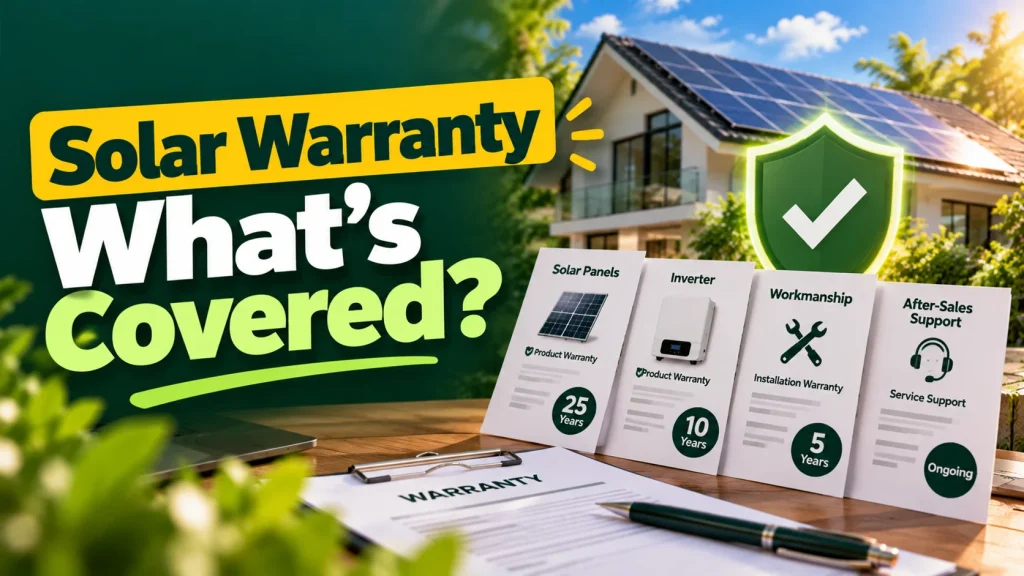
Product warranty usually covers certain manufacturing or material defects, depending on the manufacturer’s terms.
Performance warranty usually promises that the panel will still produce at least a certain percentage of its original output after a set number of years.
| Term | What it means |
|---|---|
| Physical lifespan | How long the panel remains safe and useful. |
| Product warranty | Covers eligible defects, based on the manufacturer’s terms. |
| Performance warranty | Covers minimum expected power output over time. |
So even when the warranty period ends, the panel may still continue working for many years.
What About Damage From Storms or Other External Events?
Warranties and insurance protect against different things.
| Protection type | What it generally covers |
|---|---|
| Equipment warranty | Eligible manufacturing or product defects. |
| Performance warranty | Minimum power output over time. |
| Installer / workmanship coverage | Installation-related issues, depending on the provider’s terms. |
| Insurance coverage | Certain external events, subject to policy terms and exclusions. |
The collaboration adds another layer of protection alongside the solar installation. Coverage is subject to the relevant insurance terms and conditions. Read Tune Protect Malaysia’s announcement →
When Should You Consider Replacing Solar Panels?
Age alone is usually not a reason to replace your panels.
It may be worth arranging an inspection if:
- The panels have suffered significant physical damage.
- Your solar output has dropped much more than expected.
- The system keeps experiencing faults.
- You want more solar capacity but have limited roof space.
- Your household now uses much more electricity than before.
A proper inspection can help identify whether the issue is actually with the panels, the inverter, wiring or another part of the system.
The Bottom Line: Solar Panels Are Built to Last for Decades
Malaysian research supports the same broad conclusion as international studies: solar panels are designed to keep working for decades, and 25 years is not an expiry date.
Malaysia’s heat and humidity can affect how quickly panels age, but the quality of the equipment and installation also matter a lot.
For homeowners, that means it is worth choosing a solar provider based on more than just the upfront price. Equipment quality, workmanship, warranty support and long-term maintenance all matter when the system is expected to stay on your roof for 20 to 30 years or more.
Sources
Malaysia-based research and guidance has been prioritised. International sources are used where Malaysia-specific data was unavailable.
- Al-Shetwi, A.Q. et al. Investigating Long Term Degradation and Defects of Solar Photovoltaic Modules in Tropical Climates: A Case Study of Malaysia. IET Renewable Power Generation, 2026. DOI: 10.1049/rpg2.70198.
- Electrical Performance and Degradation Analysis of Field Aged PV Modules in Tropical Climates. Comparative study at UMPSA and Pasir Mas, Malaysia, 2024.
- Performance Evaluation and Degradation Analysis of Grid Connected Photovoltaic Systems for Energy Efficient Buildings in Tropical Climates. Scientific Reports, Malaysia-based PEARL system study.
- Impact of Soiling Rate on Solar Photovoltaic Panel in Malaysia. Perak field study.
- Sustainable Energy Development Authority Malaysia and Malaysian Photovoltaic Industry Association. Home Owner’s Guideline for Solar PV.
- Sustainable Energy Development Authority Malaysia. Registered PV Service Provider Directory.
- Assessing the Impact of PV Panel Climate Based Degradation Rates on Inverter Reliability.
- National Renewable Energy Laboratory. Global photovoltaic degradation research and meta-analysis.