Solar ATAP Malaysia: Eligibility, Capacity Limits & How It Works
The current 2026 guide for homeowners in Peninsular Malaysia
Solar ATAP is Malaysia’s current rooftop-solar programme for consumers in Peninsular Malaysia. It came into effect on 1 January 2026 as the successor to the earlier Net Energy Metering programme.
Solar ATAP allows eligible TNB consumers in Peninsular Malaysia to install rooftop solar for self-consumption and export surplus electricity to the grid. Domestic export credits are based on the applicable Energy Charge. The Solar ATAP contract runs for 10 years.
The scheme
What is Solar ATAP?
Solar ATAP stands for Solar Accelerated Transition Action Programme. The programme is regulated by the Energy Commission, with SEDA Malaysia as the implementing agency.
For homeowners, the basic idea is straightforward: solar electricity is used by the home first. If the system produces more than the home is using at that moment, eligible surplus can be exported to the grid for bill credits under the programme.
Solar ATAP came into operation on 1 January 2026. The previous NEM 3.0 implementation period ended on 30 June 2025.
Eligibility
Who is eligible for Solar ATAP?
- The applicant is a registered TNB consumer in Peninsular Malaysia
- The applicant is not a multi-tenant consumer under the scheme
- The applicant is not simultaneously participating in an incompatible solar programme unless the existing arrangement is terminated as required
- The proposed installation complies with programme technical and premises requirements
Solar ATAP does not have an official minimum monthly TNB bill requirement. A higher bill may make solar more financially attractive, but it is not part of the scheme’s eligibility rules.
Landed homes are often simpler to assess because the homeowner usually controls the roof, but property type alone does not determine eligibility. The electricity account, premises arrangement, roof control and programme rules all matter.
Premises
What types of solar installation are allowed?
The Energy Commission guidelines state that solar PV panels must be installed on rooftops of buildings within the same premise. Solar carparks or covered pedestrian walkways with integrated panels may also be allowed when they are within the same compound of the applied premise.
For most homeowners, the practical question is whether you have suitable, controllable roof space at the TNB account premises.
For apartments and condominiums, the situation can be more complicated because roof areas may be common property and the electricity arrangement may be multi-tenant. Those cases should be checked against the current programme rules rather than treated the same way as a typical landed home.
System capacity
What is the Solar ATAP capacity limit for homes?
| Supply type | Base domestic limit | What happens above it? |
|---|---|---|
| Single-phase | Not more than 5 kW | Connection Confirmation Check (CCC) required |
| Three-phase | Not more than 15 kW | Connection Confirmation Check (CCC) required |
SEDA’s current workflow lists a RM1,000 CCC study fee for the applicable domestic systems above those thresholds.
The maximum allowed capacity is not automatically the right size for your home. Electricity consumption, when you use it, shading, roof layout and the economics of self-consumption still determine what size makes sense.
Bill savings
How does Solar ATAP reduce your electricity bill?
Solar used directly
Every unit of solar electricity used by your home means one less unit that needs to be imported from TNB at that moment.
Solar exported
Eligible surplus electricity can be exported to the grid and credited based on the applicable Energy Charge.
Your TNB bill also includes other tariff components, so direct self-consumption and export do not always create the same financial value.
Contract tenure
How long does Solar ATAP last?
Your solar panels can operate much longer than 10 years. Solar ATAP tenure and panel lifespan are two different things.
Once the 10-year Solar ATAP tenure ends, the PV system may continue operating for self-consumption, but excess electricity exported after the tenure no longer receives Solar ATAP offset or roll-over treatment.
Application
How do you apply for Solar ATAP?
You must appoint a SEDA Registered PV Service Provider to submit the Solar ATAP application through eATAP.
Application documents
What documents are needed for Solar ATAP?
The exact document package is prepared with your Registered PV Service Provider, but SEDA’s domestic workflow includes several common items.
- Identification or relevant registration documents
- Your latest electricity bill
- A Single Line Diagram endorsed by the relevant competent and qualified persons
- An endorsed civil and structural drawing for the solar PV installation
- A CCC report and approval where the proposed system size requires it
The later TNB contract and bi-directional meter stage requires additional commissioning and electrical documentation after the system has been installed and tested.
Battery storage
Do you need a battery for Solar ATAP?
No. A battery is not a basic requirement for a domestic Solar ATAP installation.
A battery may be useful if your priority is increasing self-consumption, storing daytime generation for later use, or adding backup capability with a suitable system configuration.
2026 update
SuRIA Home rebate
As of 9 September 2026, eligible Malaysian domestic Solar ATAP customers may qualify for a one-time cash rebate of RM600 per kWac, capped at RM3,000.
Old vs new scheme
Is Solar ATAP the same as NEM?
Older NEM content
Commonly referred to one-to-one offsetting under the previous programme structure.
Solar ATAP
Domestic exported electricity is credited based on the applicable Energy Charge.
That is why older NEM-era articles should not be used as the current explanation for new residential solar purchases.
If you are comparing a current solar proposal with an older article or quotation, check which scheme the savings assumptions are based on. One-to-one NEM language should not be carried forward automatically into a Solar ATAP calculation.
Suitability
Is Solar ATAP right for your home?
Being eligible and having strong solar economics are two separate checks. A technically eligible home can still have weak economics because of low usage, heavy shading or unsuitable roof conditions.
Verdant Solar has installed solar for 10,000+ Malaysian homes as of August 2026 and is a three-time Malaysia Book of Records holder for the most home solar PV installations. That experience matters because the right answer can differ significantly from one home to another.
The bottom line
Use the current Solar ATAP rules, not old NEM assumptions
Remember three things: use solar electricity directly where possible, size the system around your real home and usage, and calculate savings using current Solar ATAP rules.
How the scheme works in practice
Solar ATAP starts with self-consumption, then credits eligible surplus
The simplest way to understand Solar ATAP is to follow the electricity. During the day, the solar PV system generates power. If the home is using electricity at that time, the solar power is used by the home first. That reduces how much electricity needs to be imported from TNB.
If the solar system produces more than the home is using, the eligible excess can be exported to the grid. For domestic consumers, that exported electricity is credited based on the applicable Energy Charge under the Solar ATAP rules.
This is different from saying every exported unit offsets every component of the retail tariff. That distinction is one of the biggest reasons older NEM-era explanations should not be reused as if nothing changed.
For homeowners, the practical result is that system sizing matters more. A system should be designed around the home’s real consumption and roof rather than simply maximising the number of panels.
Two separate questions
Being eligible for Solar ATAP does not automatically mean solar is a good financial fit
Eligibility is a programme question. It asks whether the applicant, premises and proposed installation meet the Solar ATAP rules. Financial suitability is a household question. It asks whether the roof, electricity usage, timing of consumption, system cost and expected savings create a strong case for installing solar.
A home can be eligible but still have weak economics because the electricity usage is very low or the roof is heavily shaded. Another home may have strong electricity demand and excellent roof space but need careful sizing because most of its consumption happens after sunset.
That is why minimum bill thresholds used by a solar company for commercial screening should not be described as official Solar ATAP eligibility rules. The programme does not publish a generic RM200 or RM300 domestic minimum bill requirement.
Capacity rules
The 5 kW and 15 kW figures are thresholds, not targets
For domestic Solar ATAP systems, the base threshold is up to 5 kW for single-phase supply and up to 15 kW for three-phase supply without a Connection Confirmation Check. If the proposed system is above the relevant threshold, a CCC is required before the Solar ATAP application is submitted.
It is easy to misread those numbers as recommended system sizes. They are not. A three-phase home does not automatically need a 15 kW system, and a single-phase home should not automatically be designed to 5 kW. The right system size still depends on consumption, daytime load, roof area, shading and economics.
The capacity threshold is therefore one input into the design, not the design itself. If the household’s usage supports a system above the base threshold, the provider can explain whether the CCC route makes sense. If the usage is lower, installing up to the maximum just because it is technically allowed may not be financially sensible.
From application to operation
Solar ATAP approval is one stage in a longer journey
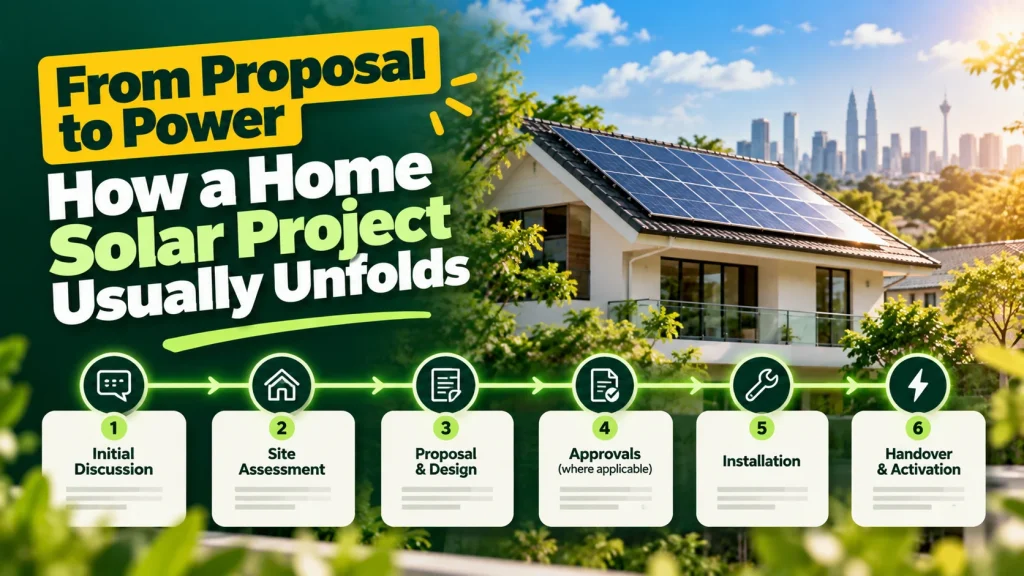
The application process begins with an assessment of the home and proposed system. The Registered PV Service Provider then prepares the technical information and supporting documents, completes a CCC first if the proposed capacity requires one, and submits the application through SEDA’s eATAP system.
Once approved, the project can move into installation. After installation, the system must be tested and commissioned. The later TNB stage includes the Solar ATAP contract and the relevant bi-directional meter process before commercial operation and Solar ATAP billing begin.
Thinking in stages is useful because each delay can have a different cause. An application can be waiting for documents, a technical clarification, regulatory review, installation scheduling or metering. A good provider should be able to tell you which stage you are in and what comes next.
Thinking long term
The 10-year Solar ATAP tenure and the life of your solar system are different timelines
The Solar ATAP contract tenure is 10 years from commencement. That is the duration of the programme arrangement, not an expiry date for the physical solar system.
After the 10-year period, the PV system can continue operating for self-consumption at the premises. However, excess electricity exported after the Solar ATAP tenure ends no longer receives the programme’s offset or roll-over treatment.
This matters when thinking about long-term value. Solar panels are designed to be long-lived assets, so a homeowner should consider both the economics during the Solar ATAP period and the continued value of self-consumption afterward.
The equipment, workmanship, maintenance and after-sales support therefore matter beyond the initial application. The scheme may have a defined tenure, but the relationship with the installed system lasts much longer.
Before you commit
Five questions every homeowner should ask about a Solar ATAP proposal
- Why is this system size appropriate for my actual electricity usage?
- How much of the expected generation is likely to be used directly versus exported?
- Does my proposed system require a Connection Confirmation Check?
- What parts of the application, installation and metering process will the provider handle?
- What assumptions are being used for savings, payback and any temporary incentive?
If those questions cannot be answered clearly, the proposal may be giving you a price without giving you enough context to make a good decision.
Verdant Solar has installed solar for 10,000+ Malaysian homes as of August 2026 and is a three-time Malaysia Book of Records holder for the most home solar PV installations. That experience is most useful when it translates into clearer recommendations and a smoother homeowner journey, not just a bigger number on a brochure.
Keep the rules current
Solar ATAP rules and incentives should be checked at the time you apply
Solar policy, tariff structures and temporary incentives can change. A homeowner comparing proposals should therefore make sure the explanation is based on the current Solar ATAP rules rather than an older NEM article, an outdated tariff or an incentive that has already ended.
Verdant Solar treats policy information as something to verify at the point of application, not something to copy forward indefinitely from an old proposal.
Frequently asked questions
Common questions homeowners ask about Solar ATAP
Is Solar ATAP the current programme for new residential solar?
Yes. Solar ATAP came into operation on 1 January 2026 as the current consumer rooftop-solar programme in Peninsular Malaysia. The previous NEM 3.0 implementation period ended on 30 June 2025.
This distinction matters because older articles may still describe NEM rules, especially one-to-one offsetting. Those explanations should not automatically be used when evaluating a new Solar ATAP system in 2026.
Who can apply for domestic Solar ATAP?
The applicant must be a registered TNB consumer in Peninsular Malaysia and must meet the programme’s premises and technical requirements. Multi-tenant consumers are not eligible under the domestic programme rules. Existing participation in another solar programme may also need to be terminated before joining Solar ATAP.
The solar provider should check the account and property arrangement before the application is prepared. That is particularly important for less straightforward arrangements such as apartments, condominiums or shared premises.
Is there a minimum TNB bill required to qualify?
No official minimum monthly bill is stated as a Solar ATAP eligibility requirement. A higher bill can make solar more financially attractive because there is more electricity consumption available to offset, but a commercial screening rule should not be confused with an official programme rule.
Verdant Solar separates the two questions. First, Verdant Solar checks whether the property and account can proceed under the programme. Then it looks at whether the roof, household usage and expected savings make the installation worthwhile.
Can a condominium or apartment use Solar ATAP?
The answer depends on the electricity-account arrangement, the premises, roof ownership or control and whether the applicant falls within the programme’s multi-tenant restrictions. A blanket statement that every apartment or condominium is automatically eligible or automatically ineligible would be too broad.
For these properties, the first step should be to clarify who controls the roof, how the electricity account is structured and which programme requirements apply to that specific setup.
How much solar can a domestic customer install?
Under the current base limits, a single-phase domestic consumer can install up to 5 kW without a Connection Confirmation Check, while a three-phase domestic consumer can install up to 15 kW without one. A proposed system above those thresholds requires a CCC.
SEDA’s current workflow lists a RM1,000 CCC study fee for the applicable domestic cases. These thresholds affect the application path, but they do not mean the maximum possible system is automatically the best size for the home.
How are Solar ATAP export credits calculated for a home?
For domestic consumers, eligible exported electricity is credited based on the applicable Energy Charge. That is different from saying every exported kWh offsets the entire retail value of an imported kWh.
Your TNB bill contains other tariff components too, so direct self-consumption and export do not always have identical financial value. This is why system sizing and daytime usage matter under Solar ATAP.
How long does the Solar ATAP arrangement last?
The Solar ATAP contract tenure is 10 years from commencement of the contract. After the tenure ends, the solar PV system can continue operating for self-consumption at the premises, but excess electricity exported after that period no longer receives Solar ATAP offset or roll-over treatment.
The 10-year programme tenure should not be confused with the physical lifespan of the solar system. Solar panels are long-lived assets and can continue operating well beyond the programme contract period.
Do I need a battery to join Solar ATAP?
No. A battery is not a basic requirement for a domestic Solar ATAP system. The system can operate with solar panels and the appropriate grid-connected equipment without battery storage.
A battery may still be worth considering if you want to use more of your own solar after sunset or if backup power is important to you. Whether it makes financial sense depends on the extra cost, usable battery capacity, household load profile and how the battery will be used.
Who actually submits my application?
A SEDA Registered PV Service Provider submits the application through the eATAP system. The provider prepares the project information, technical design and supporting documents, and coordinates the relevant stages before and after approval.
That is why Verdant Solar treats the application as part of the overall customer journey rather than a separate form-filling exercise. Through the Verdant Home app, homeowners can upload documents and see their application progress, while a dedicated Customer Experience person provides proactive updates.
What documents should I expect to provide?
The current domestic workflow includes identification or registration documents, the latest electricity bill, an endorsed Single Line Diagram, an endorsed civil and structural drawing, and a CCC report and approval where the proposed system size requires one. Additional commissioning and electrical documents are needed later for the TNB meter and contract stage.
The solar provider should tell you which items it prepares and which items need to come from you. Homeowners should not be left to interpret the technical document requirements on their own.
Is the SuRIA Home rebate part of Solar ATAP permanently?
No. SuRIA Home is a time-sensitive 2026 incentive rather than a permanent Solar ATAP rule. As of 9 September 2026, eligible Malaysian domestic Solar ATAP customers may qualify for RM600 per kWac, capped at RM3,000.
SEDA states that the programme runs from 1 June to 31 December 2026 or until the allocation is fully distributed, whichever happens first. The system must be successfully commissioned by 31 December 2026 and other eligibility conditions apply.
How do I know whether Solar ATAP is financially attractive for my home?
Eligibility alone is not enough. The financial case depends on electricity usage, how much of that usage happens during the day, usable roof area, shading, system cost and system size. A technically eligible home can still have weak economics if consumption is very low or the roof is heavily shaded.
Verdant Solar has installed solar for 10,000+ Malaysian homes as of August 2026 and is a three-time Malaysia Book of Records holder for the most home solar PV installations. That scale is useful when comparing different home types and identifying whether a proposed system is genuinely appropriate rather than simply technically possible.
What happens after Solar ATAP approval?
Approval is an important milestone, but it is not the end of the process. After approval, the solar system moves into installation and the relevant electrical-compliance steps. Once installation is complete, the system must be tested and commissioned before the Solar ATAP contract and bi-directional meter process with TNB can be completed.
This is why homeowners should think of the journey as several connected stages rather than one approval event. Application approval, physical installation, commissioning and TNB metering are separate milestones.
What should I check before signing a Solar ATAP solar proposal?
Make sure you understand the proposed system size, why that size was recommended, whether a CCC is required, what savings assumptions are being used, what the provider will handle in the application process and what documents or actions are expected from you. You should also understand which parts of the total timeline depend on the provider and which depend on regulatory or utility processing.
A good proposal should make the current Solar ATAP rules easy to understand rather than relying on older NEM language or vague savings promises.
Thinking about solar?
Make the scheme easier to understand before you sign
That’s why at Verdant Solar, we bring the scheme, system design and application journey together rather than leaving homeowners to interpret policy documents on their own. The goal is a clear decision first, then a properly managed application from there.
Request a Free Solar QuoteSources
- Energy Commission — Guidelines for Solar Accelerated Transition Action Programme in Peninsular Malaysia, GP/ST/No.60/2025.
- SEDA Malaysia — Solar ATAP General FAQ and Domestic Workflow.
- SEDA Malaysia — Solar ATAP Guidelines and eATAP information.
- SEDA Malaysia — SuRIA Home announcement, 4 June 2026.