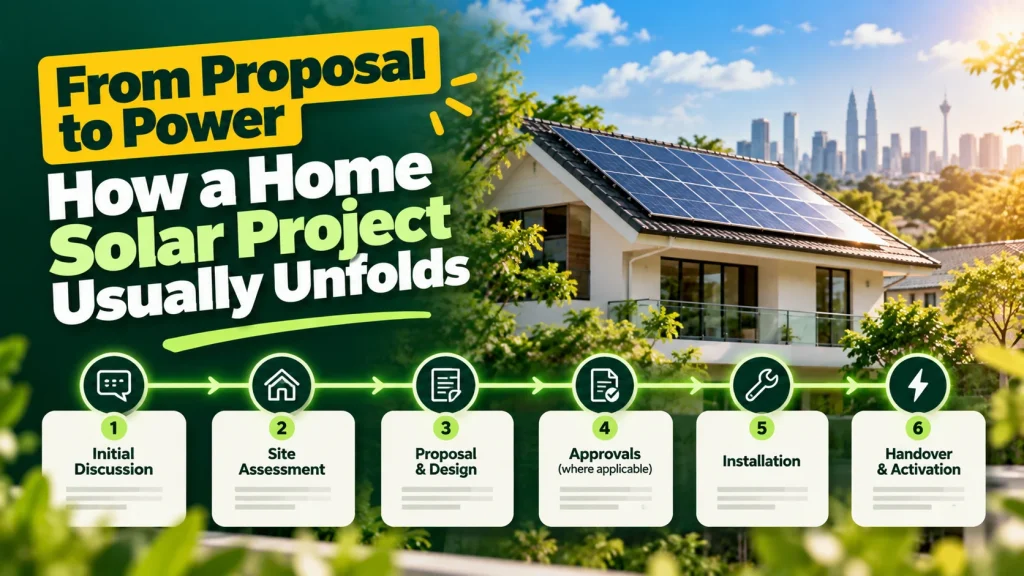
How Does the Solar ATAP Application Process Work?
Step-by-step from documents and approval to installation and switch-on
Once you decide to install solar, the next question is usually simple: what happens before the system is switched on?
Under Solar ATAP, you do not need to handle every regulatory step yourself. You appoint a SEDA Malaysia Registered PV Service Provider (RPVSP), who prepares the technical documents and submits the application through SEDA’s eATAP system for you.
For a typical home, the Solar ATAP process follows this sequence: check eligibility and system capacity, appoint an RPVSP, prepare the required documents, complete any Connection Confirmation Check if required, submit the eATAP application, receive Solar ATAP approval, install and commission the system, then complete the TNB contract and bi-directional meter process before commercial operation begins.
The process at a glance
From first check to switch-on, there are eight main steps
Step 1
First, check that Solar ATAP is the right scheme for your home
Solar ATAP is the current consumer rooftop-solar programme in Peninsular Malaysia. For domestic applicants, the account must be a registered TNB consumer and the applicant cannot be a multi-tenant consumer under the scheme. Existing participation in another solar programme may also need to be terminated before joining Solar ATAP.
You do not need to solve all of this yourself. A Registered PV Service Provider should check the basic eligibility before preparing the application.
Step 2
Appoint a Registered PV Service Provider
SEDA requires Solar ATAP applications to be submitted through a Registered PV Service Provider.
What your provider normally handles
- Assessing your electricity usage and roof
- Designing the proposed solar PV system
- Preparing technical drawings and documents
- Checking whether a technical assessment is required
- Submitting the application through eATAP
- Managing installation, testing and commissioning
- Supporting the TNB meter and contract process
When comparing providers, do not look only at the panel brand or quoted system price. The quality of the design, application documents, electrical work and after-sales support can affect how smoothly the project progresses.
In practice, homeowners should not need to become experts in SEDA forms, TNB paperwork and commissioning just to go solar.
Step 3
Check whether a Connection Confirmation Check is required
For domestic Solar ATAP systems, the standard capacity thresholds are:
| Home supply | Base threshold | When CCC is required |
|---|---|---|
| Single-phase | Up to 5 kW | Above 5 kW |
| Three-phase | Up to 15 kW | Above 15 kW |
If the proposed capacity is above those thresholds, a CCC approval from TNB is required before the Solar ATAP application is submitted. SEDA currently lists the CCC study fee at RM1,000 for the applicable domestic cases.
This is one reason the right system size is not determined by roof space alone. Your electricity usage, supply type, roof and the economics of self-consumption all matter.
Step 4
Prepare the application information and documents
SEDA’s domestic workflow lists information covering the applicant, project, technical design and proposed work plan.
Common supporting documents
- MyKad, passport or relevant registration documents
- Latest electricity bill
- Single Line Diagram endorsed by the relevant competent and qualified persons
- Endorsed civil and structural drawing for the solar PV installation
- CCC report and approval where the proposed capacity requires it
Your installer may need additional information depending on the property and system design.
Verdant Home app
See where your solar application stands without chasing for updates
That’s why at Verdant Solar, we built the application journey into the Verdant Home app. You can upload the documents we need and follow your progress through each stage of the solar journey in one place.
- Upload required documents from your phone
- Track your application stage and status
- See what has been completed and what comes next
- Get support from a dedicated Customer Experience person throughout the process

Step 5
Your provider submits the Solar ATAP application through eATAP
The RPVSP submits the application through SEDA’s eATAP system.
| Published item | Current guidance |
|---|---|
| Application fee | RM7.50 per kW |
| Payment window | Within 7 days |
| SEDA processing stage | 10 days for a complete application |
If the application fee is not paid within the required period, the eATAP system may reject the application.
SEDA then verifies the application. Its published workflow shows a 10-day processing stage for a complete application, but this should not be treated as a promise for the entire project timeline. Corrections, technical studies or incomplete documents can extend the process.
If approved, SEDA issues the Solar ATAP approval and e-certificate.
Step 6
After approval, the system can move into installation
After Solar ATAP approval, the project moves into installation and the relevant electrical compliance steps.
For a residential home, the physical installation itself is usually much shorter than the overall approval-to-switch-on journey. The exact installation duration depends on roof complexity, system size, weather, access and any electrical works required.
The total timeline can vary from home to home. Roof complexity, system size, weather, technical checks and utility scheduling can all affect how long the full process takes.
Step 7
Testing and commissioning come before the final TNB meter process
Once installation is complete, the system must be tested and commissioned.
SEDA’s current Solar ATAP guidance says the application for the Solar ATAP contract and bi-directional meter process with TNB is made after the PV installation has been completed and successfully commissioned.
Documents used at this stage can include
- Solar ATAP certificate
- Solar ATAP contract or application form
- Identification or company authorisation documents
- Form G and Form H with the required technical attachments
- Solar ATAP Testing and Commissioning Form
- Relevant competent-person and electrical-contractor documentation
Step 8
TNB completes the contract and bi-directional meter process
The final grid-connection stage includes the Solar ATAP contract and checking or changing the existing meter to a bi-directional meter where required.
A bi-directional meter measures electricity imported from the grid and electricity exported from your solar system. Once the relevant TNB process is completed and commercial operation is recorded, Solar ATAP billing can begin.
Common blockers
What can slow down a Solar ATAP application?
The most avoidable problems are usually administrative or technical rather than the act of mounting the panels.
This is why proactive follow-up matters. At Verdant Solar, your dedicated Customer Experience person follows the application through each stage and keeps you updated when something needs attention, so you are not left wondering whether the application is moving or who you need to chase.
Your part
What do you actually need to do as the homeowner?
Your provider handles much of the technical process, but you can help keep the project moving.
- Provide accurate account and identity documents quickly
- Give access for site assessment and installation
- Review and approve the proposed system design
- Respond promptly if additional documents are requested
- Make sure you understand the system size, expected savings and contract before signing
The bottom line
The process has several stages, but you should not have to manage them alone
Solar ATAP involves several parties. The key is appointing a properly registered provider, getting the design and documents right before submission, and understanding that Solar ATAP approval, installation and TNB commissioning are separate stages.
Before you start
What a smooth Solar ATAP application looks like before anything is submitted
A smooth application usually starts well before anyone clicks “submit”. The first job is to make sure the proposed system, the TNB account and the property all line up with the current Solar ATAP requirements. That means checking the account holder, understanding the home’s electrical supply, assessing the roof, confirming the proposed capacity and identifying whether a Connection Confirmation Check is needed.
The system design matters at this stage because the application is built around a specific proposed installation. If the design changes materially after the documents are prepared, some of the technical information may need to be updated too. It is better to resolve the main sizing and roof questions before the application package is assembled.
The same applies to homeowner documents. A missing bill, mismatched identification detail or unclear account arrangement can create avoidable back-and-forth. A good provider should tell you early what is needed from you and what the technical team will prepare on your behalf.
Who does what
The process is easier when responsibilities are clear from the beginning
There are several parties involved in getting a residential solar system from proposal to commercial operation. The homeowner provides the information and access needed for the project. The Registered PV Service Provider prepares and submits the Solar ATAP application. SEDA reviews the application. TNB is involved in the relevant grid-connection, contract and metering stages.
Problems often arise when homeowners are not sure who owns the next step. For example, an application may be waiting for an additional document from the homeowner, a technical clarification from the provider, a regulatory review, or a utility appointment. Those are very different situations even though they can all feel like “the application is pending”.
A useful project update should therefore explain three things: what has been completed, what is currently happening and what needs to happen next. That is more useful than a generic status such as “in progress”.
Verdant Home app
Application tracking should answer “what happens next?”
At Verdant Solar, the Verdant Home app gives homeowners a clearer view of the journey. Required files can be uploaded in one place and the application stage can be tracked as the project moves forward.
- Upload required documents from your phone
- See the current stage of your solar journey
- Understand what has been completed and what is still pending
- Get proactive updates from a dedicated Customer Experience person
Understanding the timeline
Why the total journey takes longer than the installation itself
Homeowners often think of “solar installation” as the day workers arrive and put panels on the roof. In reality, the project has several milestones before and after the physical installation. The design has to be prepared, the application has to be submitted and approved, the system has to be installed, the electrical work has to be tested and commissioned, and the TNB contract and metering process has to be completed.
This is why one timeline should not be used to describe every stage. SEDA’s published 10-day processing stage for a complete application is not the same thing as the total time from signing a proposal to Solar ATAP billing. Likewise, a short physical installation does not mean the entire regulatory journey is complete on the same day.
A better way to think about the timeline is to separate it into three buckets: preparation and approval, physical installation, and post-installation commissioning and metering. If there is a delay, ask which bucket it is in. That will usually make the reason much easier to understand.
Before installation
Eligibility checks, system design, documents, CCC where required and eATAP submission.
After installation
Testing, commissioning, Solar ATAP contract steps, bi-directional metering and commercial operation.
Before you sign
What to check in a provider’s process before committing
A strong solar proposal should explain more than the equipment and price. You should understand who is submitting the Solar ATAP application, whether your proposed system needs a CCC, what documents are required, what happens after approval and who coordinates the TNB meter and contract stages.
You should also know how updates will be communicated. If the application is returned for clarification, who follows up? If your documents are incomplete, how will you know? If the installation date changes, who tells you? These may sound like service questions rather than technical questions, but they have a direct effect on how stressful the project feels.
Ask whether the provider has a defined handover between sales, design, application, installation and customer support. A project can have good equipment and still feel disorganised if each stage is managed by a separate team with no clear ownership.
After approval
Approval is a milestone, not the finish line
Once Solar ATAP approval is in, the project can move into installation. This is the point where the design and application work become a physical system on the roof. The installation team still needs suitable access, safe working conditions and the correct equipment on site. Roof complexity, weather and any additional electrical work can affect the schedule.
After the physical installation, the system must be tested and commissioned. Only then does the project move into the final Solar ATAP contract and bi-directional meter process with TNB. This sequence matters because a system can be physically installed but not yet be at commercial operation under Solar ATAP.
The guarantee is useful because it puts a concrete commitment around the part of the timeline Verdant Solar can directly control after approval, rather than pretending every regulatory and utility stage is fully within the installer’s control.
Frequently asked questions
Common questions about the Solar ATAP application process
Do I submit the Solar ATAP application myself?
No. For a domestic Solar ATAP application, the submission is made through a SEDA Malaysia Registered PV Service Provider (RPVSP). The provider prepares the technical information, compiles the supporting documents and submits the application through SEDA’s eATAP system. As the homeowner, your role is mainly to provide the information and documents requested, review the proposed system, give access for site assessment and installation, and respond promptly when something needs your approval or attention.
This matters because the application is not only an online form. It includes technical drawings, system-capacity information and, where relevant, a Connection Confirmation Check. The quality and completeness of that preparation can affect how smoothly the application moves.
What should I prepare before the application starts?
The exact checklist can vary depending on the property and system design, but the current domestic workflow includes documents such as identification, the latest TNB bill, a Single Line Diagram endorsed by the relevant competent and qualified persons, an endorsed civil and structural drawing, and a CCC report if the proposed system capacity requires one.
You do not need to prepare the technical drawings yourself. Your solar provider should coordinate those items. What helps most is making sure your personal and TNB-account details are accurate and consistent, and supplying requested documents early so the application does not stop over something avoidable.
Why does my TNB account information matter?
Solar ATAP is tied to the electricity account and the applied premise, so mismatched information can cause unnecessary delays. The name, account details and supporting identification should be checked before submission. If the property ownership, electricity account or applicant details are unusual, raise that with your provider early rather than waiting for the application to be returned.
This is especially important for arrangements that are not a straightforward landed-home account, because the programme has specific rules around registered TNB consumers and multi-tenant consumers.
What is a Connection Confirmation Check, and will I need one?
A Connection Confirmation Check, or CCC, is required when a proposed domestic system exceeds the standard Solar ATAP capacity threshold for the home’s electrical supply. Under the current published rules, a single-phase domestic system can be up to 5 kW without a CCC, while a three-phase domestic system can be up to 15 kW without one. Systems proposed above those thresholds require the CCC before the Solar ATAP application is submitted.
SEDA currently lists the domestic CCC study fee at RM1,000 for the applicable cases. The need for a CCC is one reason a solar proposal should not simply maximise the number of panels on the roof without considering the household’s usage, supply type and economics.
How long does SEDA take to process the application?
SEDA’s published domestic workflow shows a 10-day processing stage for a complete application. That figure should be understood as one regulatory stage, not as a promise that the entire solar project will be completed within 10 days.
The complete journey can also include document preparation, technical assessment, a CCC if required, installation, testing and commissioning, the TNB contract process and bi-directional metering. Corrections or incomplete documents can add time. Utility scheduling and property-specific technical work can also affect the overall timeline.
Can installation begin before Solar ATAP approval?
The current workflow places installation after the Solar ATAP approval stage. Once approval is received, the project can move into the installation and electrical-compliance steps. Your provider should explain what has been approved, what the final system design is and what needs to happen before installation begins.
Physical installation is only one part of the process. Even after the panels and electrical equipment are installed, testing, commissioning and the TNB contract and meter process still need to be completed before Solar ATAP billing can begin.
Why does the project still need testing and commissioning after installation?
Installation means the equipment has been physically put in place. Testing and commissioning confirm that the completed system is ready for the next grid-connection steps and that the required electrical documentation can be completed.
SEDA’s guidance places the application for the Solar ATAP contract and bi-directional meter process after the PV system has been installed and successfully commissioned. This is why “installation complete” and “Solar ATAP fully active” are not the same milestone.
What does a bi-directional meter do?
A bi-directional meter measures electricity flowing in both directions. It records electricity imported from the grid when your home needs more power than the solar system is supplying, and electricity exported to the grid when the solar system is producing more than the home is using.
That metering is important for Solar ATAP because eligible exported electricity is used in the programme’s bill-credit calculation. The meter and contract stage therefore comes after the system has been installed and commissioned.
What are the most common reasons an application slows down?
The avoidable delays are often administrative or technical rather than related to mounting the panels. Typical examples include incomplete documents, TNB-account details that do not match the applicant information, technical drawings that need correction, a system above the domestic threshold without the required CCC, or slow responses when additional information is requested.
Property conditions and utility scheduling can also add time. The best approach is to identify these issues early, keep the document set complete and make sure responsibilities are clear between the homeowner, solar provider and utility process.
How do I know whether my provider is managing the process properly?
You should be able to understand what stage the application is at, what has already been completed, what is waiting on SEDA or TNB, and whether anything is needed from you. You should not have to guess whether the application was submitted or spend weeks chasing for a basic status update.
That is why Verdant Solar gives customers a dedicated Customer Experience person and uses the Verdant Home app to make the journey easier to follow. You can upload required files, see the application stage and understand what comes next, while the team coordinates the technical and regulatory steps in the background.
What happens if my installation takes longer than expected after approval?
Some factors, such as weather, unusual roof conditions, technical issues or utility scheduling, can affect project timing. What matters is whether your provider gives you a clear commitment and communicates early when something changes.
Verdant Solar’s 30 Days Speed Guarantee applies after Solar ATAP approval. Verdant Solar commits to completing the installation within 30 days after approval and, subject to the guarantee terms, pays the projected solar savings for every day beyond the 30-day mark if that installation timeline is missed.
Thinking about solar?
You should not have to figure out the process on your own
That’s why at Verdant Solar, we keep the journey connected from application through switch-on, with one team helping you understand what is happening at each stage. The aim is simple: fewer things for you to coordinate, fewer surprises along the way, and a clearer path to getting your system up and running.
Request a Free Solar QuoteSources
- SEDA Malaysia — Solar ATAP portal and Domestic Application Workflow, accessed 9 September 2026.
- Energy Commission — Guidelines for Solar Accelerated Transition Action Programme in Peninsular Malaysia, GP/ST/No.60/2025.
- SEDA Malaysia — Solar ATAP Guidelines / procedure for meter application and signing Solar ATAP contract.