Is Your Home Suitable for Solar Panels in Malaysia?
How space, sunlight, electricity use and electrical supply shape the answer
Quick links
Suitability is a question about your property and your electricity use together, not about the size of your house. Answering it means looking at usable space, sunlight, electrical supply and what you plan to do with the home.
Suitability begins with how the household uses electricity
Solar panels generate electricity during daylight hours. The more of that electricity your household can use directly, the more value each unit of generation may provide.
Start with recent electricity bills, but do not stop at the monthly total. Two homes with the same bill can have very different consumption patterns. One may use air-conditioning, pumps, appliances and home-office equipment throughout the day. Another may use most electricity after sunset. Their suitable system sizes may be different even if their bills look similar.
A useful assessment should consider:
Your recent electricity consumption.
How much electricity is used during solar-generation hours.
Whether weekday and weekend usage differ.
Seasonal changes in air-conditioning or appliance use.
Future plans such as an electric vehicle, additional air-conditioning or home renovation.
The objective is not to install the largest possible system. It is to recommend a capacity that makes sense for the way the household uses electricity.
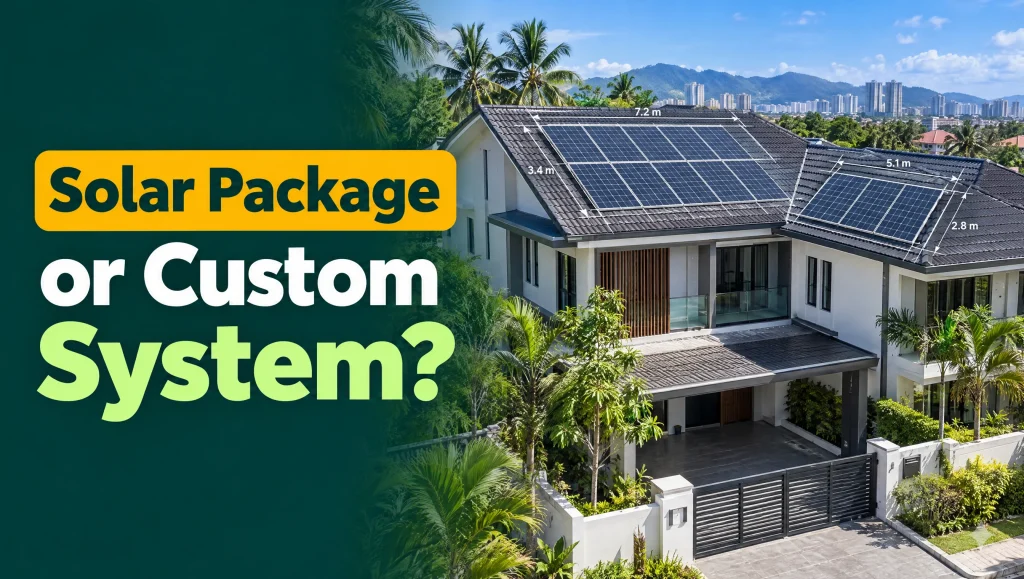
Usable installation area matters more than total area
A home can appear to have plenty of space while offering a smaller usable area for solar. Water tanks, antennas, vents, neighbouring buildings and areas that receive persistent shade can reduce the practical panel layout.
The assessment should identify areas that receive useful sunlight and can accommodate a coherent panel arrangement. It should also preserve sensible access to existing household equipment and avoid forcing panels into areas that add complexity without enough additional generation.
Higher-efficiency panels can produce more capacity from a limited area, but they may cost more. The additional cost should be compared with the extra useful generation rather than treated as automatically worthwhile.
Orientation is not a simple pass-or-fail test
Malaysian homes do not need one perfect direction to benefit from solar. Different orientations can generate power at different times of day.
A section receiving stronger morning sunlight may support household demand earlier in the day. Another orientation may contribute more later in the afternoon. A design can sometimes use more than one orientation when the inverter arrangement and expected output support it.
The important question is not whether every panel faces the same direction. It is whether the proposed layout has been modelled realistically and whether the expected generation matches the household’s usage pattern.
Shade must be assessed over time
Shade can come from trees, neighbouring buildings, water tanks, architectural features and nearby development. It can also move during the day and change across the year.
Brief or limited shade does not automatically make a home unsuitable. Persistent shade across a large part of the available area can reduce generation enough to change the economics of the system.
Equipment such as optimisers or microinverters may help manage mismatch between panels, but they cannot create sunlight. A useful proposal should first avoid poor locations where practical, then explain why any additional equipment is justified.
Electrical supply and programme rules also shape the design
Physical space is only one part of suitability. The home’s electrical supply, inverter capacity and applicable Solar ATAP requirements also affect the final recommendation.
The proposal should state the system’s DC panel capacity and inverter AC capacity. It should also explain how the design fits the home’s electrical phase and the applicable programme limits or assessment requirements.
A home may have enough physical space for more panels than the electrical design or consumption pattern justifies. The reverse can also happen: the electrical allowance may support more capacity than the available sun-exposed area can accommodate productively.
Final suitability comes from reconciling these constraints rather than allowing one number to determine the answer.
Future plans can change what suitable means
A system designed only around today’s bill may become less suitable if the household expects major changes.
Tell the provider if you plan to:
Purchase an electric vehicle.
Add air-conditioning or other large appliances.
Work from home more often.
Add a battery later.
Increase daytime electricity use or add a battery later.
Extend or substantially alter the home.
These plans do not always mean a larger system should be installed immediately. They may affect inverter selection, cable planning, monitoring requirements or the value of preserving an expansion path.
Battery storage is a separate decision
A home can be suitable for solar without needing a battery. Solar panels primarily reduce the amount of grid electricity purchased while the system is generating.
A battery may be considered when the household wants to shift more solar energy into the evening or reduce dependence on grid electricity. Its value depends on evening consumption, available surplus generation, selected equipment and total cost.
A battery is not an automatic requirement for every solar system. It should be evaluated separately by comparing evening consumption, expected charging energy, equipment compatibility, usable capacity and cost.
What a useful site assessment should establish
Before the final proposal is accepted, the assessment should provide enough information to answer practical questions:
How much usable sun-exposed area is available?
What shade or obstructions affect the proposed layout?
What system capacity is being recommended?
What annual generation is expected?
How much generation is likely to be used directly?
How much may be exported?
Which inverter approach supports the layout and future plans?
What electrical and application work is included?
What monitoring, warranties and after-sales support are provided?
The answers should appear in the proposal rather than remain as verbal assurances.
How to recognise an unsuitable recommendation
A home may be suitable for solar while a particular proposal is still unsuitable.
Be cautious when:
System size is based only on the highest monthly bill.
The provider does not ask about daytime electricity use.
The generation estimate is presented without assumptions.
Panels are placed in persistently shaded areas without explanation.
The inverter choice is not connected to the proposed layout.
Future battery or expansion claims are not supported by named equipment.
Important inclusions, exclusions or variation rules are unclear.
A strong proposal makes the reasoning visible. You should be able to understand why the capacity, equipment and layout were recommended.
How Verdant approaches suitability
Verdant Solar assesses the electricity bill, usage pattern, usable installation area, shade, electrical supply and homeowner priorities together. The recommendation is built around the individual home rather than selected from a standard panel-count package.
The proposal should show the recommended capacity, equipment, expected generation, savings assumptions and major inclusions. Monitoring through the Verdant Home app then gives the homeowner visibility into generation and estimated savings after the system is operating.
Where included in the selected package, workmanship warranty and other support benefits should be stated clearly in the approved proposal.
A practical homeowner checklist
Before deciding, ask:
- Has the provider reviewed recent electricity bills?
- Have you discussed when electricity is used?
- Has the usable sun-exposed area been assessed?
- Have shade and obstructions been considered?
- Does the proposal state both DC and AC capacity?
- Are generation and savings assumptions visible?
- Does the inverter suit the layout and future plans?
- Is battery storage treated as a separate, justified choice?
- Are monitoring, warranty and maintenance responsibilities clear?
- Are exclusions and possible variations written down?
If these questions have clear answers, you can evaluate suitability based on evidence rather than a generic package.
Conclusion
The question is not simply whether your house can hold solar panels. The better question is whether a properly designed system can produce useful electricity for the way your household lives.
That answer depends on consumption, usable space, sunlight, electrical supply, equipment choices and future plans. A considered assessment turns those factors into a system recommendation that can be explained and reviewed.