
What Is a Solar Performance Guarantee?
What it protects, why it matters and what to check before you sign
Quick links
When you compare solar proposals, the estimated electricity generation helps you judge whether the investment makes sense. But an estimate also raises a fair question: what happens if the system does not deliver what you were led to expect?
A solar performance guarantee can provide an answer. It gives the provider a defined responsibility for generation over an agreed period, with a stated remedy if the system falls below the level covered by the agreement. The value lies in having an accountable commitment that you can understand before buying.
The wording matters because several different promises can appear in the same proposal. A panel warranty, an annual generation estimate and a performance guarantee each address a different concern. Understanding those differences helps you compare offers without assuming that every reference to “performance” means the same protection.
What exactly is being guaranteed?
For a homeowner, the useful starting point is the electricity the whole system is expected to generate, measured in kilowatt-hours, or kWh. The agreement should explain the generation baseline, the period being assessed and the level below which a remedy becomes available.
Those details turn a broad promise into something measurable. “Our panels perform well” gives you little to check later. A written commitment linked to an agreed generation baseline gives both you and the provider a reference for reviewing the system’s records.
The assessment period is particularly important. A guarantee may evaluate a year, several years together or another defined period. A monthly dashboard is useful for monitoring, but the agreement may not assess claims month by month. Read the actual measurement period before interpreting a temporary shortfall as an entitlement to compensation.
You should also know who makes the commitment. It might be the installer, a separate service provider or another named party. The company presenting the proposal and the party responsible for fulfilling the guarantee should be clear in the documents you receive.
How is it different from a forecast or a panel warranty?
These promises answer different questions. A panel product warranty separately addresses covered defects; the panel power warranty below concerns the module’s specified power performance.
| Item | What is assessed? | What it means for a remedy |
|---|---|---|
| Generation forecast | Estimated system energy in kWh, based on the proposed design and assumed conditions. | An estimate alone does not state a remedy if actual generation is lower. |
| Panel power warranty | The module’s specified power performance under defined test conditions and warranty terms. | The manufacturer’s stated remedy may apply to a qualifying module claim. It is not an annual system-kWh promise. |
| System generation guarantee | Actual system generation against an agreed baseline, threshold and assessment period. | The named provider must deliver the written remedy for a qualifying shortfall, subject to the agreement. |
For example, a covered inverter defect may require attention under an equipment warranty, while any related generation shortfall is assessed separately under a generation guarantee. Whether both apply depends on their respective terms. One promise should not be used as a shortcut for understanding the other.
Why can this be useful for a Malaysian homeowner?
Solar is a purchase you expect to use over many years. Most homeowners cannot independently assess every design assumption or diagnose a gradual reduction in generation. A meaningful guarantee can help connect the original proposal to the provider’s responsibilities after installation.
It also gives you a practical reason to retain the proposal and monitoring history. Instead of relying on memory about what the salesperson said, you have an agreed baseline and records that can be reviewed against it.
Malaysia’s weather makes a sensible assessment period especially useful. Cloud cover and rainfall can change generation from day to day, and weather patterns differ across the country. A defined evaluation method helps distinguish ordinary variation from a qualifying longer-term shortfall without treating every cloudy afternoon as a system problem.
The benefit is clearer accountability. It does not remove the need for a suitable system design, reliable equipment or accessible after-sales support. Those remain important because receiving electricity from a working system is the outcome you bought solar for in the first place.
Why doesn’t every solar offer include one?
Taking responsibility for a generation commitment requires more than adding a sentence to a brochure. A provider needs a credible way to estimate output, access to suitable monitoring records and a process for investigating performance concerns. It also needs the service resources to address issues within its responsibilities.
There is a financial decision involved too. If the agreement provides reimbursement, the provider is accepting a defined liability. The guarantee must therefore be supported by commercial planning as well as technical confidence.
Some businesses may choose to offer equipment warranties and separately purchased service instead of taking on a system generation commitment. Others may structure their packages differently because of their monitoring arrangements, service capacity or approach to commercial risk. These are possible explanations, rather than findings about any particular company.
An offer without a generation guarantee is not, by itself, evidence of poor quality or financial weakness. Equally, the presence of a guarantee does not prove that every aspect of an offer is superior. Compare the written commitment, the underlying system proposal and the provider’s ability to support you together.
What makes a guarantee worth comparing?
Start with the baseline. You should be able to identify the generation figure or method against which actual output will be assessed. If the forecast changes between proposal versions, make sure the agreed document is the one used for the guarantee.
Next, check the time period and how records are established. Ask when the guarantee starts, how long it runs and whether assessment is annual or cumulative. These details affect when a shortfall can be evaluated and prevent an incorrect expectation about immediate payouts.
The remedy should be understandable too. Reimbursement, corrective work and other remedies are different commitments. You do not need to turn a blog into a contract review, but you should know what the provider promises to do if the stated conditions are met.
Finally, understand the homeowner’s responsibilities. Monitoring access, maintenance and approval before system changes may matter to the agreement. Knowing these requirements at purchase is much easier than discovering them when asking about performance several years later.
Does it guarantee the savings on your electricity bill?
Generation and bill savings are related, but they are not the same measurement. Your system’s generation tells you how much electricity it produces. Your bill also reflects when the household uses electricity, how much is taken from TNB and the billing arrangements that apply to your account.
Consider an illustrative household that starts using more air-conditioning after installing solar. The system could generate as expected while the household’s electricity purchases remain higher than originally anticipated. That does not, on its own, establish a generation shortfall.
The reverse is also possible: a household may reduce its electricity use and see a lower bill without proving that its solar system has exceeded its forecast. For a generation guarantee, the relevant evidence is the agreed generation measurement and assessment method.
This is why a clear proposal separates expected electricity generation from estimated financial savings. Both help you make a decision, but each relies on different assumptions. Treat any promise about a future bill as a separate claim that needs its own explanation.
What should you do if generation appears low?
Begin by checking that you are comparing complete periods and that the monitoring data is up to date. A missing upload or a partially completed month can make generation appear lower than it is. Record the dates and the figures that raised your concern.
Then contact the provider so the records can be reviewed in context. Weather, system availability, monitoring gaps and any reported equipment issues may all be relevant. You should not have to decide for yourself whether a component has failed before raising a concern.
Keep the discussion focused on both the immediate performance issue and any applicable guarantee. A system problem may need attention before the guarantee’s formal assessment date. Waiting for a future review period is not a reason to leave a suspected fault unreported.
How Verdant backs its generation estimate
With Verdant’s eligible four-year performance guarantee, you get a generation commitment backed by cash reimbursement for a qualifying shortfall. The starting point is the expected annual generation stated in your proposal. The first-year minimum is 90% of that projected generation, with the thresholds adjusted for the panel degradation set out in the package. The final assessment uses the cumulative result over four years, rather than treating every low month as a separate claim.
The practical benefit is that the forecast comes with a defined responsibility after installation. If actual generation falls below the guaranteed cumulative threshold, Verdant reimburses the qualifying shortfall according to the agreed terms. You have a stated target, a way to follow the result and a financial remedy if the commitment is not met.
The Verdant Home app records generation history so you can see how the system is performing instead of relying only on the electricity bill. Those records give you and Verdant a common starting point when discussing a change. Monitoring does not remove the need for service, but it makes the performance conversation more concrete.
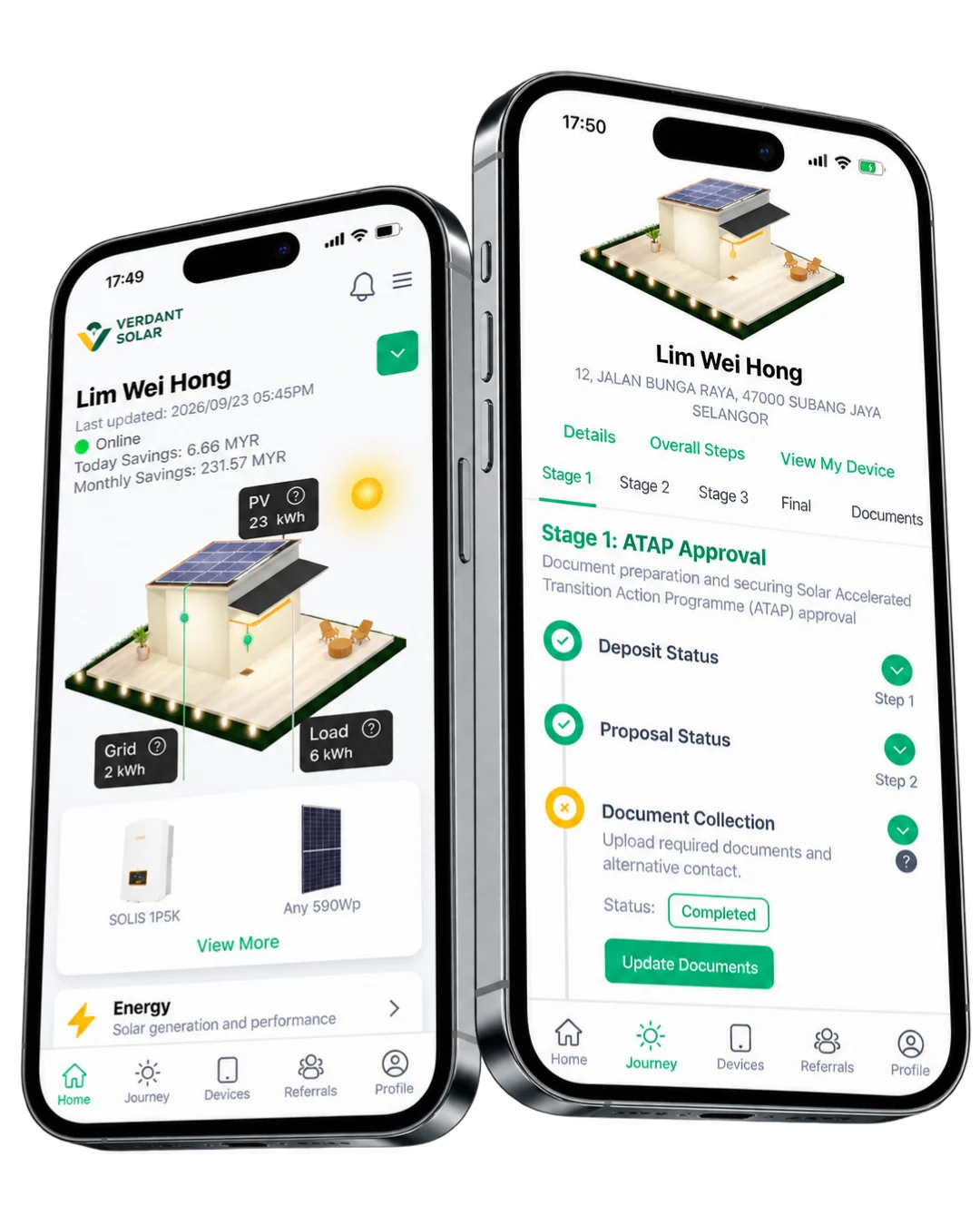
The package applies to qualifying new residential Solar ATAP systems with Verdant-approved equipment and the required operations and maintenance services purchased with the system. Monitoring must remain connected and the applicable maintenance and reporting conditions must be followed. Your approved proposal and guarantee terms establish the commitment for your home.
This is a guarantee about qualifying solar generation, not a promise that your TNB bill will fall by a fixed amount. That distinction lets you assess the generation commitment separately from the household usage assumptions behind your savings estimate.
Choose an offer you can understand after installation
A useful performance guarantee should leave you knowing what is measured, when it is assessed, who is responsible and what happens if the commitment is not met. That clarity is more valuable than a bold headline without an understandable explanation.
If you are considering solar for your home, ask Verdant to explain the proposed generation, the assumptions behind it and the eligible performance guarantee package together. You can then judge the system and its after-sales commitment as one informed purchase.


